Pantry Staple Science Helps Engineering Team Rethink the Laws of Physics
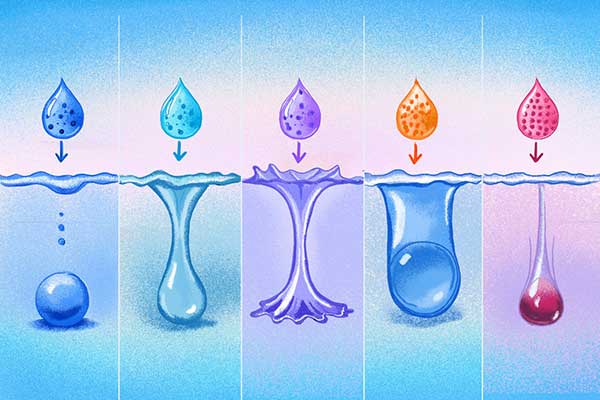
MIE Assistant Professor Xiaoyu Tang and graduate student Boqian Yan, MS’24, PhD, mechanical engineering, published research in Physical Review Fluids mapping five distinct behaviors of particle-heavy droplets—like oobleck—colliding with liquids, offering insights that could advance precision 3D printing, pharmaceutical manufacturing, and environmental pesticide application.
This article originally appeared on Northeastern Global News. It was published by Katya Poltorak. Main photo: Droplets containing cornstarch and water have some unusual properties. Tang and Yan pinned down their behavior. Illustration by Renee Zhang
These researchers are demystifying oobleck, Dr. Seuss’s ‘green goo’
Northeastern researchers use cornstarch to outline five behaviors of particle-containing droplets. The findings have implications for 3D printing and the environment.
Cornstarch can thicken your egg drop soup or serve as a base for a DIY shampoo, but there’s more to the humble pantry staple. Given the right conditions, it seems to defy the laws of physics.
Mixing cornstarch with water creates oobleck — a shape-shifting substance classified as a non-Newtonian fluid that changes states when subjected to a force. Leave it alone, and it oozes like liquid. Stir it up, and it gets more viscous before locking into a solid. Under certain conditions, if it’s punctured, it can even fracture, according to Northeastern University researchers. The thickening phenomenon is known as the oobleck effect.
Back in 1949, Dr. Seuss made oobleck famous as the “green goo” wreaking havoc on a fictional kingdom that a boy named Bartholomew endeavors to rescue. But today, Northeastern mechanical and industrial engineering scientist Xiaoyu Tang and Ph.D. student Boqian Yan are using the same mix of ingredients for a different purpose.
After receiving the 2025 NSF Career Award grant last year, they set out to take a deep dive into the behavior of water droplets containing solid bits of cornstarch. The results, published in Physical Review Fluids this June, have implications for 3D printing, the environment, and more.
Non-Newtonian materials, like oobleck, have many practical uses. According to Nanografi, a global nanotechnology company, they’re used to make printer inks, brake fluids and noise reduction dampers for washing machines. They’re also the secret behind the Mous AiroFoam phone case, famous for viral ad campaigns featuring pricey devices surviving air balloon drops intact thanks to a hardening response similar to the oobleck effect.
However, there are lots of gaps in the knowledge of how non-Newtonian droplets that contain particles behave, especially when they collide with liquids.
To shed light on the matter, they used a syringe pump to launch droplets containing different concentrations of cornstarch into a pool of water at various impact velocities, the speed and direction of an object at the moment it hits a surface.
Read full story at Northeastern Global News