Bringing AI and Robotics to New England’s Seafood Industry
ECE Professors Taskin Padir and Hanumant Singh are collaborating on the newly launched, National Science Foundation-backed “Seafood Engine” in New England, a multi-state initiative utilizing a $15 million grant to revitalize the regional seafood industry and reduce the U.S. seafood trade deficit through advanced technologies like robotics and AI.
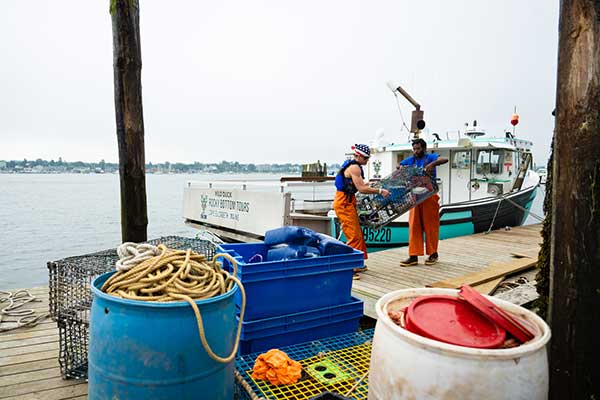
This article originally appeared on Northeastern Global News. It was published by Cyrus Moulton. Main photo: The NSF Seafood Engine in New England convenes the seafood industry, tech sector, government and research partners like Northeastern. Photo by Alyssa Stone/Northeastern University
Northeastern researchers want to help keep New England seafood from going to China and back
The NSF Seafood Engine in New England is a collaboration of the seafood industry, tech sector, government and research partners.
The longfin squid that ends up on your plate as calamari may have been caught in Rhode Island, but it’s likely traveled to China and back again for processing before being served.
That example is illustrative of what’s known as the “seafood deficit,” a roughly $20 billion trade deficit due to the U.S. importing 80% to 90% of the seafood it consumes. For instance, more than 80% of squid caught in Rhode Island is frozen and shipped to China for processing, then refrozen and imported back to the United States, according to the Westerly Sun.
“It’s not because we don’t have seafood, it’s because we don’t have the capacity to process it,” said Taskin Padir, professor of electrical and computer engineering at Northeastern.
A new “Seafood Engine” backed by the U.S. National Science Foundation (NSF) hopes to address that and other issues by convening research partners, including Northeastern University, the technology sector and fishers to revitalize the New England seafood industry. The project aims to expand domestic seafood processing, grow the industry workforce and utilize technology to break through the supply chain bottlenecks.
“We’re bringing these very diverse sets of people together, and working on a common problem,” said Hanumant Singh, professor of electrical and computer engineering and mechanical and industrial engineering at Northeastern who is participating in the engine. “We want the science, we want the engineering, we want the fisheries people, and we want it to be a win-win-win for all.”
The NSF Seafood Engine in New England is a collaboration of the seafood industry, tech sector, government and research partners across Maine, Massachusetts, New Hampshire and Rhode Island. The project, one of the NSF’s Regional Innovation Engines, will initially receive an award of $15 million over two years, with the potential to grow up to $160 million over 10 years as it works to build an internationally competitive technology and innovation cluster.

Northeastern’s Hanumant Singh and Taskin Padir are among the researchers who will both participate in the seafood engine. Photos by Matthew Modoono/Northeastern University
“NSF Engines investments in critical technologies and future industries will transform America’s innovation infrastructure for decades to come,” said Brian Stone, performing the duties of the NSF director. “The NSF Seafood Engine will leverage cutting-edge resources, including AI, advanced manufacturing, biotechnology, robotics and more to strengthen the New England seafood supply chain, from harvesting to consumer delivery, supporting businesses up and down the coastline.”
Read full story at Northeastern Global News