The Power of Mentorship: How Northeastern’s Young Scholars Program Elevates Faculty and Graduate Roles
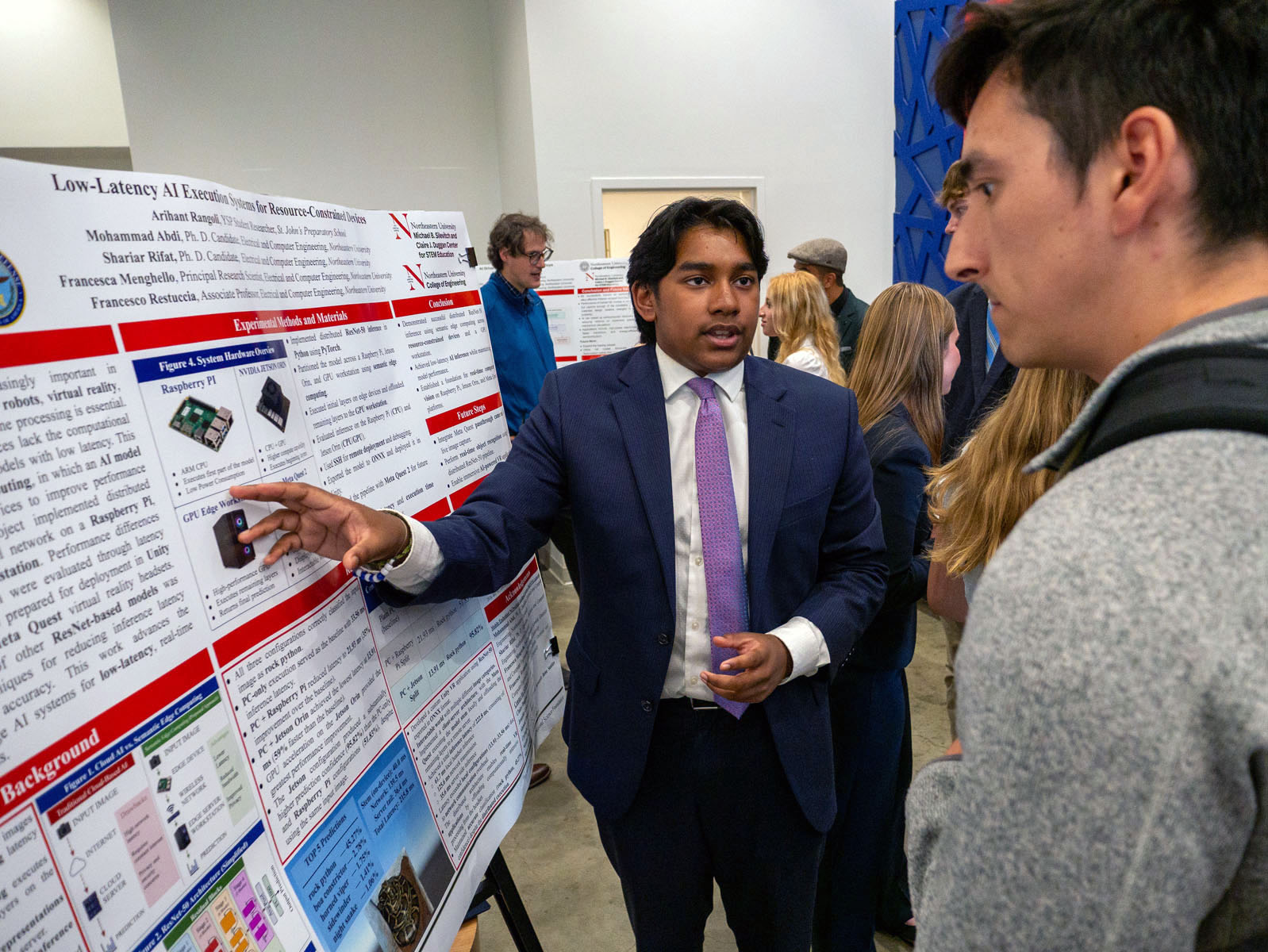
At Northeastern University’s Michael B. Silevitch and Claire J. Duggan Center for STEM Education, a six-week summer program is quietly transforming the way faculty and graduate students think about mentorship—and giving rising high school seniors a shot at research most won’t see until college.
Since 1990, the Young Scholars Program (YSP) has placed more than 600 high school seniors into Northeastern research labs, immersing them in projects that go far beyond typical high school science and engineering fairs. Roughly 99% of participants go on to pursue STEM majors, a track record the program leaders attribute not just to lab access, but to how mentorship itself is structured.
“It’s not supervision—it’s a vertical mentoring approach,” is how faculty describe it: a chain of support running from professors down through graduate students to the scholars themselves, with everyone benefiting along the way.
A Two-Way Street: Professional Development for Mentors
Professor of Electrical and Computer Engineering Marvin Onabajo, one of the program’s faculty mentors, says the arrangement pays off for the participating graduate students as much as it does for the high schoolers. Fielding questions from scholars encountering a field for the first time forces graduate mentors to step outside their narrow technical focus and explain their work in plain terms, a skill, Onabajo notes, that doesn’t come naturally in a research environment built around specialists talking to specialists.
Graduate student Surafel Mustefa Beyan, who mentors Young Scholars on Associate Professor for Chemical Engineering Joshua Gallaway’s battery electrode spectroscopy project, put it more simply: teaching, he found, is often the best way to learn. Walking scholars through complex material forced him to sharpen his own understanding of it, a dynamic mentors across the program describe as a “two-way street,” where guiding a younger student through the research process comes back around as fresh insight for the mentor.
From High School Labs to University Research
Part of what makes that exchange necessary is the gap the Young Scholars Program is built to close. High school labs tend to focus on single-step procedures with predictable outcomes; university research rarely works that way. Mentors walk scholars through multi-step processes instead, moving from formulas on a page to the physical, often unglamorous work of preparing and testing materials to get results that hold up.
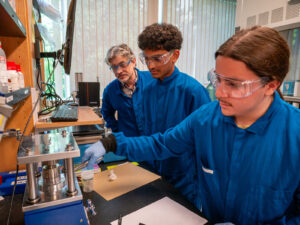
Chemical engineering professor Joshua Gallaway supporting STEM program efforts. The two high school students in his lab work on the project ‘Spectroscopy of Battery Electrodes’ project with graduate student Surafel Mustefa Bayan (not pictured).
That gap-bridging shows up clearly in Gallaway’s battery fabrication project, one of the program’s featured 2026 assignments. Young Scholars Alexander Braga (John D. O’Bryant School of Mathematics and Science) and Taru Kannan (Acton-Boxborough Regional High School) spent the summer producing alkaline battery cathodes from copper oxide, learning to fabricate and “cycle” coin cell batteries to measure their performance, and using Raman spectroscopy to observe battery behavior in real time—research with direct relevance to rechargeable alkaline batteries for the power grid. It’s the kind of project, mentors say, that only works if someone is standing beside the student explaining not just what to do, but why.
Another opportunity to close the gap between the classroom and everyday life came when Associate Professor of Chemical Engineering Sara Hashmi led a lunchtime workshop on “Household Chemistry,” designed to get scholars thinking about the chemical, physical, and material properties hiding in things they use every day.
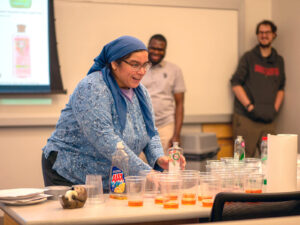
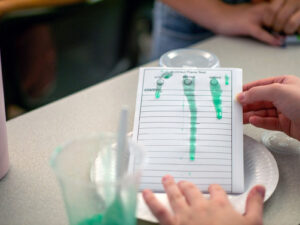

In one demo, students adjusted the electrostatic interactions in surfactant solutions to change their rheological properties—in plain English, they added salt to soap or shampoo until it “broke,” turning much thinner and less viscous. In another, they stabilized emulsions using surfactants, adding soy sauce and other everyday additives to oil and vinegar to delay the two from separating.
Beyond the Bench
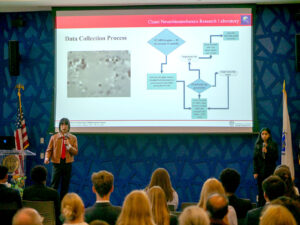
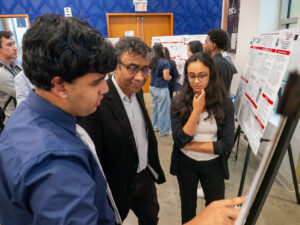
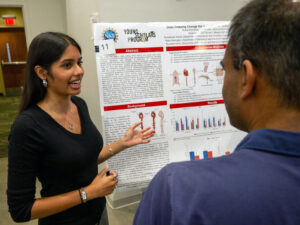
The mentorship extends well past lab technique. Scholars work with faculty, graduate mentors, and STEM Center staff, including Nick Fuchs, along with program coordinators who are themselves YSP alumni, on college applications, personal essays, and seminars covering different engineering disciplines. By the time scholars reach the program’s closing poster and presentation session, they’re prepared to defend their methods and communicate findings to people outside their field, much as they would at a professional research symposium.
A Model Built to Last
Executive Director Claire Duggan, who founded the program in 1990, has watched that support structure hold up across three and a half decades. The vertical mentoring model, spanning the full research hierarchy from faculty to graduate students to scholars, is precisely what allows students to succeed in an advanced lab environment they wouldn’t otherwise be ready for.
The result, mentors say, is something bigger than a summer internship: a research culture where mentor and mentee grow together, and where teaching turns out to be one of the best ways to keep learning.
Learn more about the 2026 YSP projects, faculty, graduate students, and students’ experiences.