New All Terrain Robot Snuffs Out Wildfires With Liquid Nitrogen
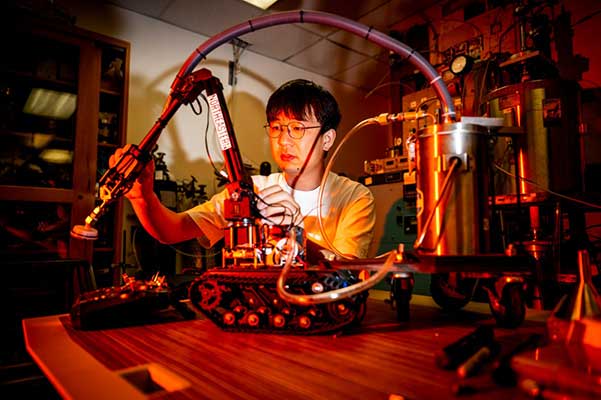
MIE Professor Yiannis Levendis and a team of students have developed an all-terrain, mobile prototype robot that utilizes a residue-free cryogenic spray to safely suppress and smother dangerous wildfire hotspots before they expand out of control.
This article originally appeared on Northeastern Global News. It was published by Rich McKay. Main photo: Aobo Liu, who studies mechanical engineering, works on professor Yiannis Levendis’s firefighting robot in the Snell Engineering building. Photo by Matthew Modoono/Northeastern University
This robot can snuff out wildfires with a cryogenic spray
Northeastern University professor Yiannis Levendis built a firefighting machine that “suffocates” flames.
About 20 years ago, Yiannis Levendis, a professor of mechanical and industrial engineering at Northeastern University, was working on an experiment to find an alternative to coal – grinding up old car and truck tires and burning the crumbs.
When he was igniting rubber tire bits in his lab back in 2008, on impulse, he fetched a spoonful of liquid nitrogen and threw it on the flames.
“Liquid nitrogen, when thrown on fire, quickly evaporates and expands into gas almost 1,000 percent,” he said. “That suffocates the fire and creates a cooling effect on the fuel.”
And that’s exactly what happened. “It was almost instant extinguishment,” Levendis said.

A prototype of a firefighting robot uses a cryogenic liquid to snuff out wildfire hotspots. It is being developed by Northeastern University. Photo by Matthew Modoono/Northeastern University
He knew that liquid nitrogen had been used to help stop fires deep in coal mines, but he thought they could also be developed to fight wildfires.
According to the National Interagency Fire Center, more than 5.13 million acres were scorched by wildfires in the U.S. in 2025. That’s more than 8,000 miles, or the equivalent size of Massachusetts.
He was especially hopeful about the approach because, unlike other retardants used to fight in wildfires, liquid nitrogen leaves no chemical residue that could damage the soil or harm the environment, Levendis said.
Many fire retardants used on wildfires today contain phosphorus, a chemical used in fertilizers, and according to the U.S. Geological Survey, in heavy concentrations, it can run off into streams and ponds. That can cause algae blooms that can kill fish and other aquatic lifeforms. Some retardants also contain sodium ferrocyanide, a chemical that can hurt the soil, the agency said in a 2002 report.
Even with the cryogenic as an alternative, Levendis needed a delivery system.
Spray it from firetrucks with special tanks and cold-resistant hoses? Drop it from helicopters with newfangled scoops to contain the cryogenic material until needed?
“Neither are far-fetched,” said Levendis, who has frequently developed new ideas at Northeastern University, such as using corn stalks or old plastics as a coal replacement.
But his ultimate answer for this project: robots.
Read full story at Northeastern Global News