Unlocking Plant Secrets for Safer Medicine and Resilient Crops
COS/BioE Professor Jing-Ke Weng, director of the Institute for Plant-Human Interface, is studying natural plant processes to discover safer cancer treatments, develop a potential peanut allergy vaccine, and breed resilient crops capable of advancing global health and sustainability.
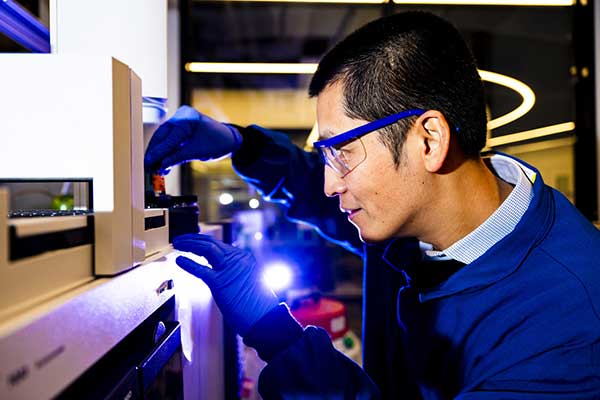
This article originally appeared on Northeastern Global News. It was published by Cody Mello-Klein. Main photo: Northeastern professor Jing-Ke Weng works in his lab on the Boston campus. Photo by Alyssa Stone/Northeastern University
Meet the researcher who thinks plants could help save the world
“I’m really, really humbled by plants all the time,” said Northeastern’s Jing-Ke Weng, the director of the Institute for Plant-Human Interface.
Jing-Ke Weng thinks plants can save us.
The director of Northeastern University’s Institute for Plant-Human Interface has dedicated his career to understanding what makes plants tick –– and how those lessons could change humanity. The work he and the members of his institute are doing to bioengineer the processes that plants naturally do will help create new drugs and more resilient crops, they say.
A biochemist, Weng has discovered hormonal pathways in toxic foxglove that could make cancer drugs safer. He is tracking exactly where in our bodies peanut allergies take place, research that could lead to a vaccine for the common food allergy. He even figured out how certain plants create an almond-scented compound that could be reproduced to bioengineer flavored drinks on the moon.

Northeastern University professor Jing-Ke Weng says people tend to be humancentric, “But if we think about it, there are so many elements that are coming to our lives that originated from plants.” Photo by Alyssa Stone/Northeastern University and Illustration by Renee Zhang
“Plants have done a lot of things right to survive and thrive in this terrestrial environment,” Weng said. “We really need to learn from them.”
Weng spoke with Northeastern Global News about his groundbreaking work, where his interest in plants started and why humans should pay more attention to the plants around them.
Read full story at Northeastern Global News